
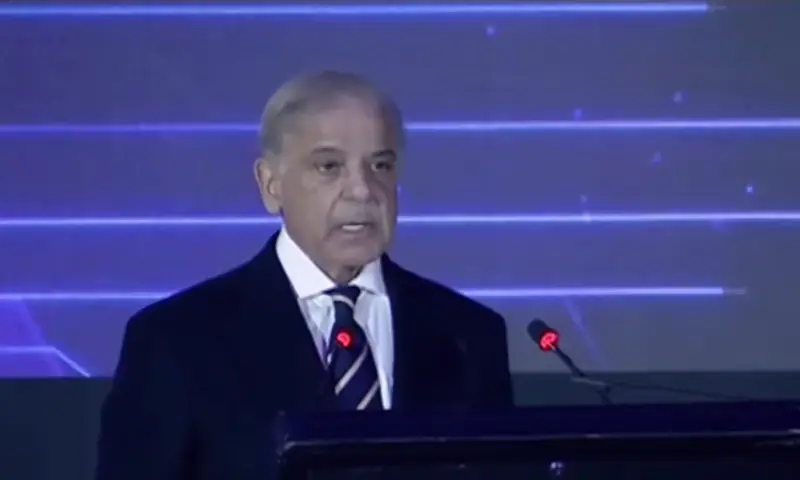
Prime Minister Shehbaz Sharif on Monday announced that Pakistan will invest $1 billion in artificial intelligence by 2030, outlining a series of education, research and workforce initiatives aimed at building what he described as a national AI ecosystem.
The announcement was made at the inauguration of Indus AI Week 2026 in Islamabad, a week-long event running from February 9 to 15 that organisers describe as the country’s official national platform for artificial intelligence, bringing together policy, innovation, talent and investment. Addressing the opening ceremony, the prime minister said the planned investment would support Pakistan’s long-term technological and economic development.
“The Government of Pakistan is committed to investing $1 billion in AI by 2030, which will go a long way in building an AI ecosystem in our country,” Shehbaz said, according to remarks broadcast from the event.
As part of the broader initiative, the prime minister said the government would introduce an artificial intelligence curriculum across all federally run and controlled schools, as well as educational institutions in Azad Jammu and Kashmir and Gilgit-Baltistan. He added that the programme would also be extended to remote areas of Balochistan, with the aim of preparing young people for leadership roles in the digital economy.
Shehbaz said the education measures were designed to ensure nationwide access to emerging technologies rather than concentrating opportunities in major urban centres. He said empowering young people was central to the government’s plans, noting that youth account for around 60 per cent of Pakistan’s population.
In addition to curriculum reforms, the prime minister announced that the government would fund 1,000 doctoral scholarships in artificial intelligence by 2030. The scholarships, he said, would be open to students from across the country and were intended to support the development of a “world-class research centre fully capacitated” to contribute to advanced AI research and innovation.
Shehbaz also said a nationwide skills initiative would be launched to train one million non-IT professionals in artificial intelligence applications. The programme, he said, would focus on enabling workers from a range of sectors to use AI tools to improve productivity and livelihoods.
“Last but not least, we will launch a nationwide programme to train one million non-IT professionals in AI skills, enabling them to enhance productivity and improving livelihoods,” he said.
The prime minister said Pakistan was ready to engage with international partners in pursuing these goals. “Pakistan is absolutely ready to accept the challenge and walk with our global partners, absolutely with great commitment and dedication,” he said.
He identified agriculture and the mines and minerals sector as priority areas where artificial intelligence could be applied to improve efficiency and output. According to Shehbaz, the government sees AI as a means to modernise traditional sectors while creating new opportunities for employment and innovation.
At the start of his address, the prime minister described Indus AI Week as a potential turning point for the country’s technology sector. He said the event would not only influence Pakistan’s technological direction but could have a broader impact on national development. “This is going to not only change the technological landscape of Pakistan, but this will be nothing short of a game-changer,” he said.
Shehbaz also referred to cooperation with what he described as friendly and brotherly countries, saying Pakistan would pursue its technology ambitions through collaboration and shared pathways.
Reflecting on past initiatives, the prime minister said previous governments had sought to align Pakistan with modern requirements and challenges. He recalled his tenure as chief minister of Punjab, when, he said, various programmes were launched to support education, health and youth development.
Among those initiatives, he cited the launch of a laptop distribution scheme in schools and colleges in Punjab in 2010, which he described as an effort to familiarise students with digital tools and encourage technology adoption at an early stage.
Officials said further details of the AI investment plan, including timelines and implementation mechanisms, would be developed in consultation with relevant ministries and stakeholders as part of the broader Indus AI Week discussions.