
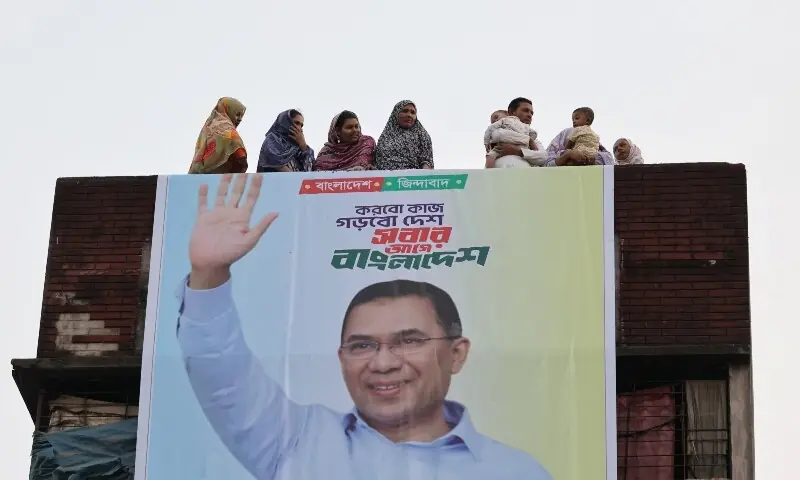
Bangladesh’s Nationalist Party (BNP) has set out a reform-focused political and economic programme after securing a two-thirds majority in the country’s general election, positioning itself to return to power following two decades in opposition.
The decisive result comes after months of political turbulence that followed the removal of former prime minister Sheikh Hasina in a youth-led uprising. The BNP, led by Tarique Rahman, is expected to form the next government. Rahman, son of party founder and former president Ziaur Rahman, is widely anticipated to assume the premiership.
The party’s manifesto, titled “Bangladesh before all”, outlines priorities spanning constitutional reform, employment, trade, welfare and public services.
On governance, the BNP has pledged to implement the provisions of the July Charter, a framework aimed at restructuring state institutions. The charter calls for the creation of new constitutional bodies and the introduction of a bicameral parliament. The party says it will pursue broader institutional changes in line with commitments made during talks among political groups in the wake of recent unrest.
In trade and industry, the BNP has promised measures to revive shuttered factories and expand the country’s export base beyond traditional sectors. It has also committed to ensuring that foreign companies operating legally in Bangladesh are able to repatriate profits within 30 days, a move aimed at improving investor confidence.
Employment generation is another central plank of the platform. The party has pledged to create nearly one million jobs in the information and communication technology sector. It has also promised to introduce a wage structure linked to inflation, with reviews every two years, and to ensure merit-based recruitment in government service. Youth development plans include expanding technical and language training to improve employability at home and abroad.
On the economy more broadly, the BNP has proposed introducing international payment systems and establishing regional e-commerce hubs to integrate Bangladesh more fully into global digital trade. It has also vowed to promote domestic manufacturing under a “Make in Bangladesh” initiative. For low-income households, the party has promised to launch a “Family Card” programme that would provide monthly support for the purchase of essential goods.
Healthcare spending is set to rise under the BNP’s plans. The party has said it would gradually increase public health expenditure to 5 per cent of gross domestic product. It has also pledged to recruit 100,000 health workers nationwide and to expand preventive healthcare services.
In the social sector, the BNP has proposed introducing a nationwide mid-day meal programme for students and developing a new education policy focused on skills and values. It has also committed to improving sports infrastructure and training facilities.
Additionally, the party has outlined plans to establish training-based welfare programmes for religious leaders of all faiths, to be conducted at places of worship.
The BNP’s wide-ranging agenda reflects an attempt to combine institutional reform with economic revival and expanded social support, as it prepares to assume office amid expectations of political stabilisation following a period of upheaval.