
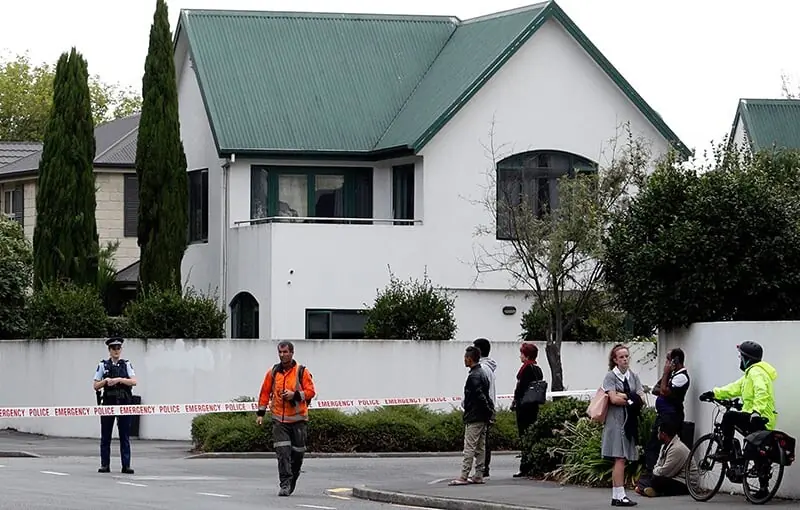
The man responsible for the 2019 shootings at two mosques in New Zealand’s Christchurch, which left 51 people dead, has lodged an appeal against his convictions, arguing that the conditions under which he was held during his trial undermined his ability to make informed legal decisions.
Brenton Tarrant, an Australian national who carried out what remains New Zealand’s deadliest mass shooting, appeared before the Court of Appeal in Wellington on Monday. Court documents show that Tarrant is seeking to overturn his convictions on the grounds that his detention during pre-trial and trial proceedings was, in his words, “torturous and inhumane”, leaving him mentally incapable of rationally deciding to plead guilty.
Tarrant was sentenced in August 2020 to life imprisonment without the possibility of parole, the most severe sentence ever imposed in New Zealand. He had pleaded guilty to 51 counts of murder, 40 counts of attempted murder and one charge of engaging in a terrorist act.
According to a synopsis of the appeal released by the court, Tarrant contends that the isolation and restrictions he faced while in custody affected his mental state to such an extent that his guilty pleas were not the product of free and informed choice. He is currently held in a specialist unit at Auckland Prison designed for prisoners assessed as posing an extreme risk, where his contact with other inmates and staff is tightly controlled.
“I did not have the mind frame or mental health required to be making informed decisions at that time,” Tarrant told the court, according to reporting by the New Zealand Herald. In submissions referenced during the hearing, he said his thinking during that period was so impaired that he had contemplated making false claims about the attack, including attempting to implicate then US president Donald Trump.
National broadcaster RNZ quoted Tarrant as saying he had considered suggesting the existence of a second shooter or attributing responsibility to Trump, comments cited by the defence to illustrate what they described as his disordered state of mind at the time of his plea.
If the Court of Appeal rejects Tarrant’s challenge to his convictions, it would then consider, at a separate hearing later this year, an appeal against the sentence itself. His punishment of life imprisonment without parole marked the first time such a sentence had been imposed in the country’s legal history.
Tarrant carried out the attacks on March 15, 2019, when he opened fire on worshippers at the Al Noor mosque and the Linwood Islamic Centre in Christchurch. Armed with multiple semi-automatic weapons, he killed 51 people and wounded dozens more. The victims included men, women and children, all of whom were Muslim.
Before the attacks, Tarrant posted a manifesto online outlining his white supremacist ideology. He also livestreamed the assault for 17 minutes, footage that spread rapidly online before being taken down. Facebook later said it removed around 1.5 million videos within the first 24 hours that showed or referenced the attack.
Security around Monday’s appeal hearing was tightly controlled. Only lawyers, court officials and accredited media were permitted to attend in person. Families of those killed or injured were invited to watch the proceedings remotely from Christchurch via a delayed video feed, while members of the public could view the hearing from a separate courtroom in Wellington, also with a one-hour delay.
Aya Al-Umari, whose brother Hussein was killed in the Linwood mosque attack, told the Christchurch newspaper The Press that she had believed the legal process was over when Tarrant was sentenced in 2020. “I thought this is the end of it,” she said. “Little did you know that you are allowed to do this six years later. I was not prepared to do this.”
The appeal is being heard by a panel of three judges. As is customary in Court of Appeal proceedings, the judges are expected to reserve their decision and issue a written ruling at a later date, meaning no outcome is anticipated immediately.
The Christchurch attacks prompted swift legislative and political responses in New Zealand. Then prime minister Jacinda Ardern moved quickly to tighten the country’s gun laws, banning most semi-automatic firearms. Her government also pushed for greater accountability from technology companies, urging social media platforms to take stronger action against extremist content.
In 2021, Tarrant’s former lawyer, Tony Ellis, said his client believed that pleading guilty was “the simplest way out”, arguing that the decision had been made under pressure. Ellis’s comments were cited by defence lawyers as part of the broader context for the current appeal.
The identities of Tarrant’s current legal representatives have been suppressed by court order.