
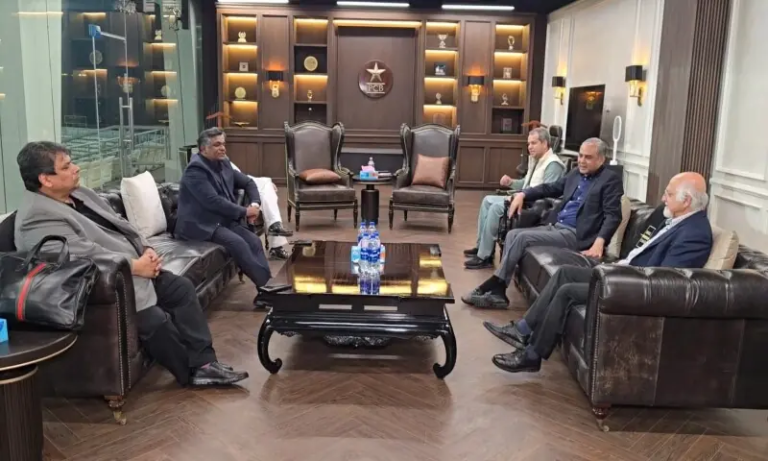
Officials from the International Cricket Council (ICC) met representatives of the Pakistan and Bangladesh cricket boards in Lahore on Sunday to discuss Pakistan’s decision to boycott its T20 World Cup group match against India scheduled for February 15, according to officials and board statements.
The meeting took place at Gaddafi Stadium and continued late into the night, with all sides declining to brief the media while discussions were under way. Sources familiar with the matter said any formal announcement on the outcome was likely to be made only after consultations with the government of Pakistan and receipt of its endorsement.
The talks were attended by International Cricket Council deputy chair Imran Khawaja, who arrived in Lahore earlier in the day, and Pakistan Cricket Board chairman Mohsin Naqvi. Also present was Bangladesh Cricket Board president Aminul Islam Bulbul, who travelled separately to Lahore for consultations related to the issue.
The PCB confirmed Khawaja’s arrival in a post on X, saying he was received at Lahore airport by Amir Mir, an adviser to the PCB chairman. In a separate statement, the board said Naqvi met Bulbul at Gaddafi Stadium, where the two discussed what the PCB described as the “ongoing crisis” surrounding the tournament. Pakistan Super League chief executive Salman Naseer, who also serves as an adviser to the PCB chairman, attended the meeting, along with Mir. The BCB president thanked Pakistan for its support in the T20 World Cup matter, according to the PCB.
The high-level meetings came a day after the ICC Men’s T20 World Cup began. The 20-team tournament has been overshadowed by a political dispute following Bangladesh’s exclusion after it declined to play its matches in India, citing security concerns. India is one of the co-hosts of the event.
Bangladesh had asked the ICC to relocate its fixtures to Sri Lanka, but the request was rejected. After Bangladesh refused to participate under the original schedule, the ICC replaced the team with Scotland, a move that prompted criticism from Dhaka and drew support from Islamabad.
After reviewing the situation, Pakistan allowed its team to take part in the tournament but announced it would not play the group-stage match against arch-rivals India, which is scheduled to be held in Colombo. Pakistan’s position was communicated after internal deliberations, though the ICC issued a statement responding to reports of the boycott even before receiving formal notification from the PCB.
In that statement, the ICC said selective participation was difficult to reconcile with the principles of a global sporting event, where all qualified teams are expected to compete under the agreed schedule. The governing body said it hoped the PCB would consider the long-term implications of its stance for cricket in Pakistan, noting that such decisions could affect the global cricket ecosystem of which Pakistan is a member.
The ICC added that its priority remained the successful delivery of the tournament and said it expected all member boards, including the PCB, to work toward a mutually acceptable resolution that protected the interests of all stakeholders.
A government source in Islamabad said Pakistan’s refusal to play India was intended as a show of solidarity with Bangladesh following its removal from the tournament. According to the source, officials viewed the ICC’s handling of Bangladesh’s security concerns as biased and believed a boycott of the India match was an appropriate protest.
“The government of Pakistan wanted to show solidarity with Bangladesh,” the source said, adding that the national team had been restricted from playing the February 15 fixture for that reason.
Any match between India and Pakistan is among the most commercially valuable events in international cricket, generating significant broadcast, sponsorship and advertising revenue. Media reports earlier in the week said the ICC had initiated back-channel efforts to resolve the dispute and avoid substantial financial losses linked to the potential forfeiture of the match.
Sri Lanka’s cricket board also contacted the PCB, urging Pakistan to reconsider its decision. Sri Lanka Cricket officials warned that a boycott would have financial consequences and could harm Sri Lanka’s tourism sector, which has been recovering from the economic crisis of 2022. The India–Pakistan match is scheduled to be played in Colombo, and Sri Lankan authorities see the fixture as a major draw for visitors.
From a sporting perspective, a forfeit would also affect Pakistan’s campaign. Under tournament rules, Pakistan would lose two points if it does not play the match and would suffer a negative impact on its net run rate, a key factor in qualification for the knockout stages. Pakistan opened its campaign with a win over the Netherlands on Saturday.
Team captain Salman Agha said earlier that if Pakistan were to meet India later in the tournament, such as in a semi-final or final, the team would again consult the government before taking a decision.
As talks in Lahore continued, officials maintained silence on whether a compromise was within reach. Sources said discussions focused on balancing Pakistan’s stated political position with the ICC’s insistence on full participation and the commercial and competitive implications for the tournament. Any final decision, they added, would depend on coordination between cricket authorities and the Pakistani government, leaving uncertainty over whether the February 15 match will go ahead as scheduled.